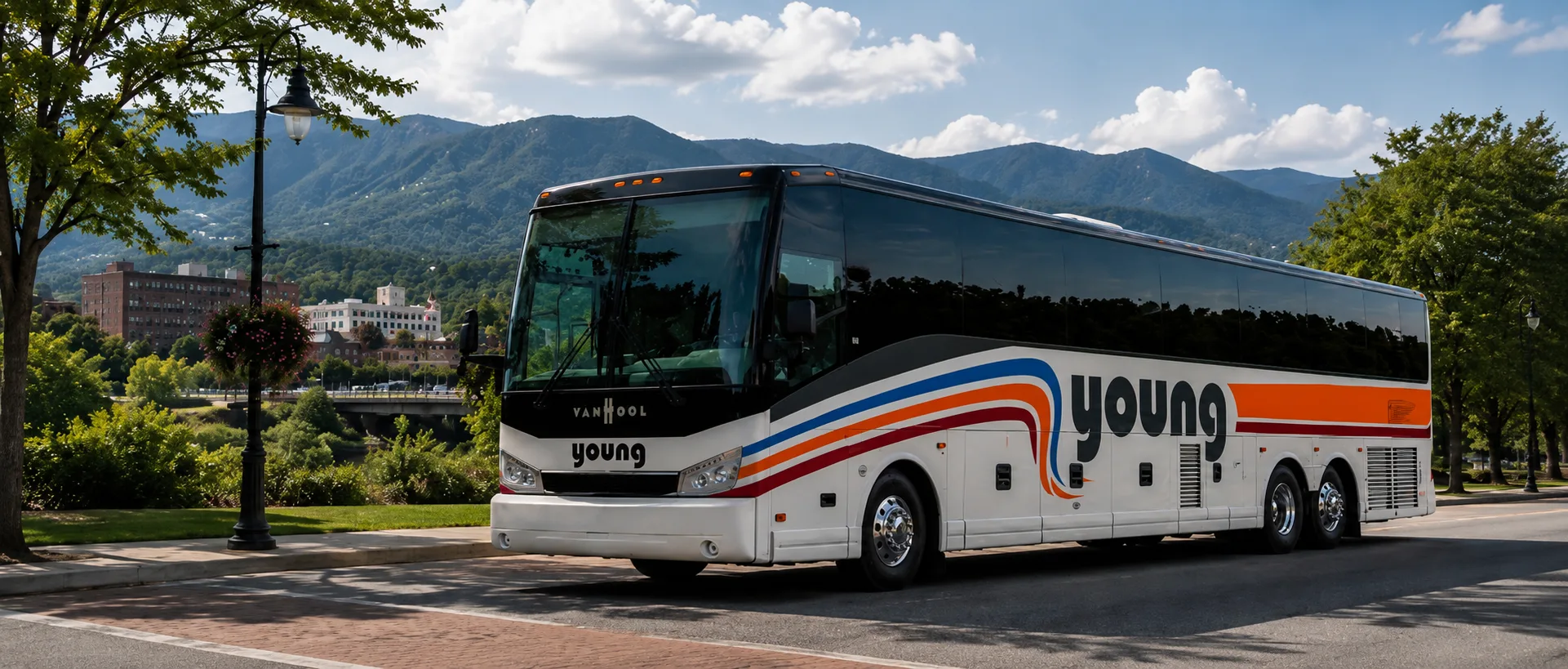

Group size is the first question any transportation company will ask you. It’s also the variable that determines everything else — which vehicle is appropriate, whether your gear fits, how the pickup logistics work, and what the trip will cost.
Charter bus sizes range from luxury vans (8–14 passengers) to full-size motorcoaches (40–56 passengers), with activity buses and minibuses filling the middle range. The right size depends on your confirmed headcount, luggage volume, trip distance, and pickup requirements — not just which vehicle sounds right for the occasion.
Get the size right and the rest of the planning falls into place. Get it wrong — too small and someone gets left behind, too large and you’re paying for capacity you don’t need — and it creates problems that are hard to fix close to the departure date.
This guide walks through every vehicle size Young Transportation operates, explains what each is best suited for, and gives you a practical framework for making the call.
Key Takeaways
- Charter bus sizing ranges from luxury vans (8–14 passengers) to full-size motorcoaches (40–56 passengers).
- Headcount is the starting point, but luggage, equipment, trip distance, and pickup location all influence the final vehicle choice.
- Booking the right size vehicle matters more than booking the largest one available — oversizing adds cost without adding value.
- When headcount is uncertain, build in a buffer rather than cutting it close. A few empty seats is a much smaller problem than an overloaded vehicle.
- A transportation company with a varied fleet can match vehicle to trip — ask them to recommend, not just quote.
Why Vehicle Size Is the First Decision to Make
Most people start their charter bus search by thinking about the occasion — a wedding, a school trip, a corporate event. That’s natural, but it’s not the most useful first step. The occasion tells you the context; the headcount tells you the vehicle.
Vehicle size affects everything downstream: whether your group fits comfortably, whether the luggage fits at all, what the pickup logistics look like, and ultimately what you pay. A company that quotes you without asking about your group size isn’t doing the job properly.
The good news: getting the size right isn’t complicated once you understand the options. Here’s a clear breakdown of each vehicle category.
The Charter Bus Size Options
Young Transportation operates motorcoaches, activity buses, and luxury vans. Here’s how they compare:
| Vehicle Type | Passenger Capacity | Best For | Luggage Storage | Restroom | Highway Travel |
| Luxury Van | 8-14 | Small groups, executive travel, airport transfers | Limited | No | Yes |
| Minibus / Activity Bus (Small) | 18-24 | Small-to-mid groups, short trips, school field trips | Moderate | No | Yes |
| Activity Bus (Mid-Size) | 28-36 | Mid-size groups, sports teams, church travel | Moderate–Good | Varies | Yes |
| Full-Size Motorcoach | 40-56 | Large groups, long-distance travel, events | Excellent | Often yes | Yes |
A few important notes on reading that table:
Capacity figures represent maximum seating. For long trips — anything over two hours — building in a few empty seats improves comfort meaningfully. A 36-passenger group on a long haul is more comfortable in a full-size motorcoach than packed into an activity bus at capacity.
Luggage storage varies within categories. Under-coach bays on a full-size motorcoach provide significant baggage space. Activity buses have overhead racks and sometimes a rear luggage area, but they’re not designed for heavy gear loads. If your group is traveling with checked-bag-level luggage or sports equipment, that needs to be part of the vehicle conversation — not an afterthought.
A Closer Look at Each Vehicle
Luxury Van (8–14 passengers)
The luxury van fills the gap between a large SUV and a minibus. It’s the right tool for small executive groups, VIP airport pickups, wedding party transportation, and situations where the group is small but the expectation is a step above a rideshare.
What it doesn’t do well: long-distance travel with luggage. Cargo space is limited, and hours on a highway in a van — however comfortable — isn’t what this vehicle is designed for. For small groups covering real distance, a step up to an activity bus usually makes more sense.
Best for: corporate executive transfers, small wedding parties, airport pickups for senior leadership, small family groups on short local trips.
Activity Bus — Small (18–24 passengers)
This is one of the most versatile vehicles in the fleet. It’s maneuverable enough to handle school campus pickups and event venue access that a full-size coach can’t easily navigate. It seats a meaningful group without the operational overhead of a full motorcoach.
The limitation is luggage capacity. An activity bus at 22 passengers doesn’t have much room left for significant gear. School groups with backpacks are fine; a youth sports team with equipment bags is a tighter fit.
Best for: school field trips, smaller church groups, corporate team outings, short-distance group transfers, weddings with a smaller guest shuttle need.
Activity Bus — Mid-Size (28–36 passengers)
The mid-size activity bus handles a range of group sizes that don’t quite justify a full motorcoach but have outgrown the smaller options. It’s a common choice for youth sports teams, mid-size church groups, and corporate groups moving between local venues.
At this size, luggage starts to be a more significant planning variable. If the group is traveling with equipment — gear bags, instruments, presentation materials — confirm the luggage configuration with your transportation company before booking.
Best for: youth sports teams, mid-size corporate groups, church retreats, school trips with moderate group sizes, event shuttles.
Full-Size Motorcoach (40–56 passengers)
This is the vehicle most people picture when they think “charter bus.” It’s built for long-distance travel and large groups. Under-coach luggage bays handle significant gear loads. Most full-size coaches include reclining seats, climate control, restrooms, power outlets, and Wi-Fi — making them the right choice for any trip where passengers will be on board for an extended time.
The full-size motorcoach is less maneuverable than smaller vehicles. Tight school campus loops, narrow event venue driveways, and dense urban pickup points can create logistical challenges. It’s worth raising pickup location specifics with your transportation company when you’re working through the details.
Best for: large school trips, athletic team travel, corporate conference transportation, weddings with large guest counts, family reunions, multi-day group tours, convention and event shuttles.
Explore our full fleet and vehicle specs here.
How to Choose the Right Size for Your Trip
Start with confirmed headcount — not a round number
The most common sizing mistake is booking based on an estimate that turns out to be wrong. “About 40 people” has become a 44-person group more times than any transportation coordinator would like. Get an actual headcount — or as close to one as your timeline allows — before selecting a vehicle.
A good rule: if you’re genuinely uncertain, size up rather than down. A few empty seats costs nothing. An overloaded vehicle creates a real problem, especially if there’s no way to source an additional vehicle on short notice.
Factor in luggage and equipment before finalizing the vehicle
Passenger count gets the vehicle to the right category. Luggage and equipment determine whether it actually works.
A 32-person sports team with full gear bags may need a vehicle — or vehicle configuration — that accounts for significantly more cargo than 32 passengers with light personal items. The same is true for school groups with project materials, corporate groups with presentation equipment, and wedding parties with dress bags and decorative items.
When you describe your trip to a transportation company, include what’s coming with the group — not just how many people.
Match the vehicle to the trip distance and duration
Shorter local transfers have more flexibility on vehicle comfort. A 45-minute shuttle between a hotel and a venue doesn’t require a full-size motorcoach with reclining seats.
Longer trips change the calculation. Any trip over 2–3 hours puts a premium on seat comfort, climate control, restroom access, and the ability to move around slightly. A group that’s technically within an activity bus’s capacity may be better served by a full-size motorcoach for a 4-hour drive — the per-seat cost difference is often worth the added comfort on a long haul.
Think about where the vehicle needs to go
Vehicle size affects more than how many people fit. It affects where the vehicle can physically operate.
Full-size motorcoaches need adequate turning radius, clearance height, and staging space. School campuses with tight loop driveways, downtown pickup points with narrow streets, and event venues with underground parking decks all have physical constraints that influence vehicle choice. If the destination has known access limitations, flag them early — a transportation company with multiple vehicle types can often find a workable solution that a single-vehicle fleet cannot.
Quick Reference: Vehicle Size by Trip Type
| Trip Type | Recommended Vehicle | Key Consideration |
| Executive airport transfer (4–8 pax) | Luxury Van | Punctuality, professionalism |
| Small school field trip (18–22 students) | Activity Bus (small) | Campus maneuverability |
| Youth sports team (25–32 + gear) | Activity Bus (mid-size) | Equipment space |
| Church retreat (30–40 members) | Activity Bus (mid) or Motorcoach | Comfort on longer drive |
| Corporate conference shuttle (40–50 pax) | Full-Size Motorcoach | Reliability, schedule precision |
| Wedding guest shuttle (30–55 guests) | Activity Bus or Motorcoach | Venue access, timing |
| Large school trip (45–56 students) | Full-Size Motorcoach | Luggage, distance, restroom |
| Family reunion / group tour (40+ pax) | Full-Size Motorcoach | Long-distance comfort |
For more detail on how vehicle choice applies to specific trip types, see our service pages for School Transportation, Sports Transportation, Corporate Transportation, and Our Fleet.
Common Vehicle Sizing Mistakes
Booking based on “probably around” instead of confirmed numbers. Transportation planning built on uncertain headcount creates problems that surface at the worst time. Get the actual count, or get close enough that you’re sizing for the realistic upper end.
Ignoring equipment and luggage entirely. A vehicle that fits 30 people doesn’t automatically fit 30 people’s gear. This catches first-time renters off guard more than almost anything else.
Choosing the smallest vehicle to minimize cost without checking trip distance. The cost savings on a smaller vehicle can evaporate quickly if the group is uncomfortable for a long trip. Comfort matters more at mile 200 than it does at mile 20.
Assuming the largest vehicle is always safest. Oversizing isn’t just a cost issue — it can create real logistical problems if the vehicle doesn’t fit the destination’s physical access requirements.
Not telling the transportation company about the pickup location specifics. A company that knows where you’re picking up and dropping off can flag access issues before they become day-of problems.
Conclusion
Vehicle sizing isn’t complicated once you know the options. The decision comes down to confirmed headcount, realistic luggage volume, trip distance, and where the vehicle needs to go. Get those four variables right and the vehicle choice follows naturally.
If you’re between sizes, or unsure how your specific trip maps to a vehicle type, that’s exactly the kind of conversation our team handles every day. We’d rather work through the details with you upfront than have the wrong vehicle show up on departure morning.
If you’re planning transportation for an upcoming trip, our team is happy to help you match the right vehicle to your group and build a plan around your route and schedule.
Request a Quote — no obligation, and we typically respond within one business day.
Or call us directly: (800) 622-5444
Questions People Ask
How many passengers does a charter bus hold?
It depends on the vehicle type. Luxury vans hold 8–14 passengers. Activity buses range from 18 to 36, depending on the model. Full-size motorcoaches seat between 40 and 56. The right vehicle depends on your headcount, luggage volume, and trip type — not just the number of seats.
What’s the difference between a minibus and an activity bus?
The terms are often used interchangeably. In general, an activity bus or minibus refers to a mid-capacity vehicle (roughly 18–36 passengers) that’s larger than a van but smaller than a full-size motorcoach. The specific configuration varies by manufacturer and fleet. When in doubt, describe your group size and ask the transportation company which vehicle fits.
Can a charter bus hold luggage for everyone?
Full-size motorcoaches have substantial under-coach luggage bays designed for extended travel. Activity buses have more limited storage — overhead racks and sometimes a rear luggage compartment. For groups with significant gear (sports equipment, large bags, instruments), luggage capacity should be confirmed before booking, not assumed.
Is a full-size motorcoach always the best option for large groups?
Not always. It’s the right choice for large groups traveling long distances with significant luggage. For large groups on a short local transfer — between a venue and a hotel, for example — a different configuration may work just as well at a better price point. The destination’s access constraints also matter: some venues can’t accommodate a full-size motorcoach.
What if my group size is right on the boundary between two vehicle types?
Book the larger vehicle. The comfort and logistical flexibility of a few extra seats is worth more than the marginal cost savings of cutting it close. Unexpected additions to headcount — late RSVPs, parent chaperones, last-minute additions — are common.
Can Young Transportation recommend the right vehicle for my trip?
Yes — that’s part of what we do. When you request a quote, we’ll ask about your group size, luggage, trip type, and destination to recommend the right vehicle rather than just offering a price for whatever you asked about. A good transportation partner helps you make the right call, not just the easy one.