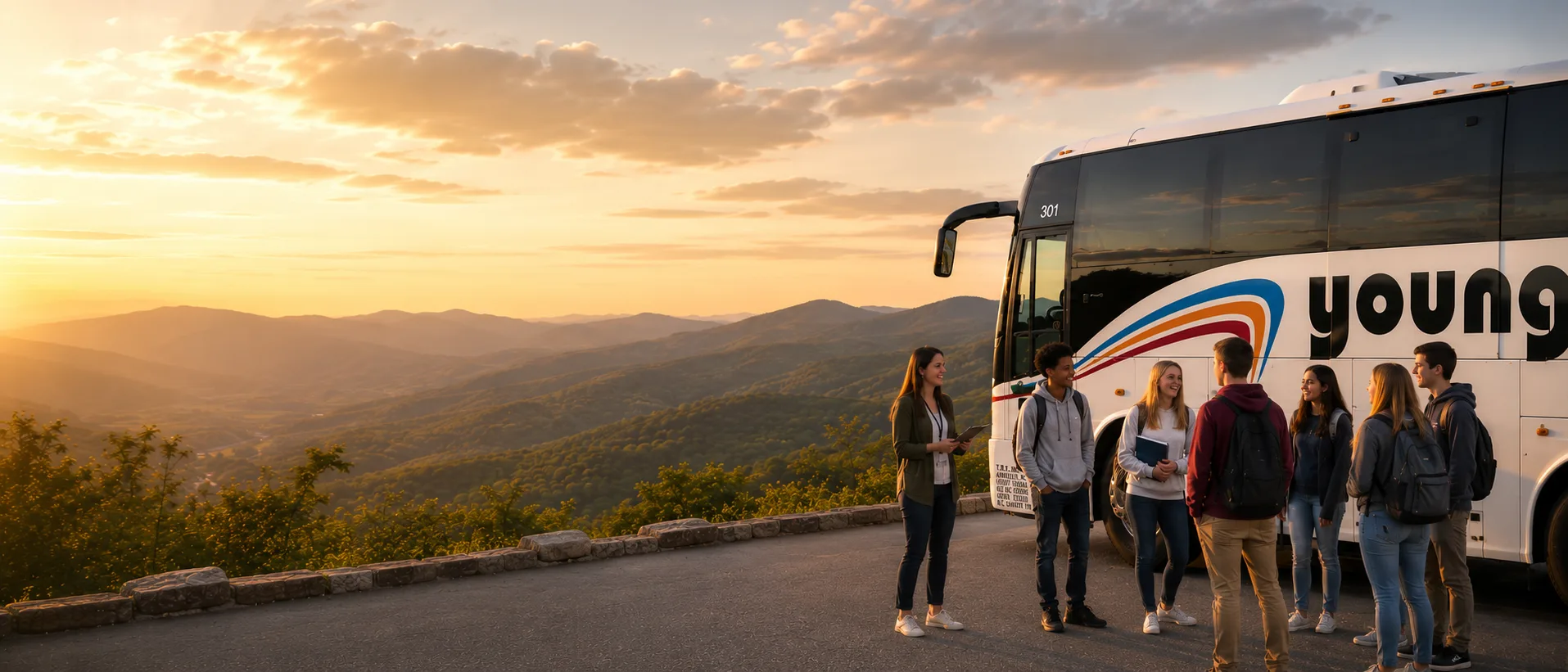

There’s a reason teachers keep coming back to Asheville.
Within a few hours of the mountains, you have a working estate that shaped American architecture, one of the most biodiverse temperate forests on the continent, a living museum of Appalachian craft and Cherokee heritage, and a downtown that doubles as a walkable lesson in early 20th-century urban history. Asheville and the surrounding Western North Carolina region don’t just support the curriculum — in many cases, they make it come alive in ways a classroom never quite can.
This guide is for teachers, school administrators, educational tour organizers, and homeschool groups planning a trip to the region. It covers the best educational destinations, practical planning advice, sample itineraries, and transportation considerations that help groups of all sizes move through the region efficiently.
At a Glance — Asheville & Western NC Educational Group Travel
- Best for: Teachers · School administrators · Homeschool groups · Educational tour organizers · College faculty · Youth organizations
- Top destinations: WNC Nature Center · Biltmore Estate · NC Arboretum · Folk Art Center · AMOS · Pisgah National Forest · Thomas Wolfe Memorial
- Curriculum connections: Life science · Ecology · Earth science · US history · Architecture · Appalachian culture · Environmental studies · American literature · STEM
- Grade levels: All grades · Strongest programming depth for Grades 4 and up
- Best seasons: Spring (late March–May) · Fall (September–October)
- Typical trip length: One day (day trip) · Two days (recommended for full curriculum coverage)
- Vehicle options: Activity buses (18–36 passengers) · Full-size motorcoaches (40–56 passengers)
- Book: 4–8 weeks in advance minimum · Spring school travel season fills fast
Why Asheville and Western North Carolina Are Exceptional for Educational Travel
Most educational travel destinations are strong in one or two subject areas. Asheville is genuinely cross-curricular.
History and culture. Western North Carolina sits at the intersection of several rich historical threads: Cherokee heritage, Appalachian settlement, Gilded Age architecture, the Arts and Crafts movement, and early 20th-century literary history. Students studying any of these can find primary-source experiences here that textbooks can only describe.
Environmental science and ecology. The Southern Appalachians are one of the most biodiverse regions in the temperate world. The elevation range in Western NC — from river valleys to peaks above 6,000 feet — creates layered ecosystems that provide exceptional material for ecology, botany, geology, and conservation studies.
Arts and living traditions. Asheville has one of the highest concentrations of working artists and craftspeople per capita of any city in the Southeast. The craft traditions of the region — woodworking, pottery, weaving, glassblowing, blacksmithing — connect directly to Appalachian history and remain active today.
Outdoor education. Pisgah National Forest, the Blue Ridge Parkway, and dozens of waterways and trail systems give groups hands-on access to forestry, geology, environmental stewardship, and conservation topics.
Accessibility and logistics. Asheville is within a day’s drive of most of the Southeast and Mid-Atlantic. The region has a well-developed infrastructure for group travel, with venues accustomed to school and educational groups.
Spring and fall are the prime seasons for educational group travel — mild temperatures, manageable crowds, and natural settings at their most instructive. Fall foliage typically peaks in mid-to-late October across the higher elevations. Spring wildflower season runs from late March through May.
Best Educational Attractions in Asheville and Western North Carolina
Biltmore Estate
Educational value: American history, architecture, agriculture, Gilded Age economics, horticulture
Recommended ages: Grades 5 and up
Approximate visit length: 3–5 hours
Curriculum connections: US history, economics, architecture, environmental science
Ideal season: Year-round; spring gardens are exceptional
Biltmore Estate is the largest privately owned home in the United States and one of the most significant examples of late 19th-century American architecture and landscape design. George Vanderbilt commissioned the estate in the 1890s, and the story of its construction, workforce, agricultural operations, and eventual opening to the public touches on labor history, the Gilded Age, the rise of the conservation movement, and the work of Frederick Law Olmsted, who designed the estate’s grounds and approach road.
For educators, the estate offers guided group programs across several subject areas. The winery, working farm, and managed forest land — descended from what became the nucleus of Pisgah National Forest — extend the learning beyond the house itself. Students studying American history, economics, architecture, or horticulture will find substantive content throughout.
Group rates and educational programs are available through the estate’s group sales department. Advance booking is essential, particularly in spring and fall.
See details on Biltmore’s website
Western North Carolina Nature Center
Educational value: Wildlife biology, conservation, Appalachian ecosystems, native species
Recommended ages: All ages; particularly strong for grades K–8
Approximate visit length: 2–3 hours
Curriculum connections: Life science, ecology, conservation biology, environmental studies
Ideal season: Spring and fall
The WNC Nature Center is an accredited zoo and wildlife center focused entirely on the animals and ecosystems of the Southern Appalachians. Students encounter native species including red wolves (one of the rarest animals in North America), river otters, cougars, black bears, and a wide range of Appalachian wildlife in habitats designed to reflect their natural environments.
What sets the Nature Center apart for educational travel is its dual mission: animal care and conservation education. Staff naturalists lead programs aligned to state curriculum standards, and teachers can book group programs in advance that integrate directly with what students are studying in class.
For younger students especially, this is often the most impactful stop on an Asheville educational trip. The center is city-operated and prices reflect that — it’s consistently one of the most accessible attractions in the region for school budgets.
See details on WNC Nature Center’s website
Asheville Museum of Science (AMOS)
Educational value: Regional geology, minerals, fossils, natural history
Recommended ages: Grades 3 and up
Approximate visit length: 1–2 hours
Curriculum connections: Earth science, geology, paleontology, natural history
Ideal season: Year-round (indoor)
AMOS focuses on the natural science of the Southern Appalachians, with collections and exhibits centered on regional geology, minerals and gemstones, fossils, and natural history. The Southern Appalachians are among the oldest mountain ranges on Earth, and the geological story of the region is both scientifically significant and genuinely engaging for students.
For earth science and geology units, AMOS provides context that’s hard to replicate. Teachers who want students to understand the geological forces behind the landscapes they’re visiting will find this a useful early stop on an Asheville itinerary.
See details on AMOS’ website
Folk Art Center and the Southern Highland Craft Guild
Educational value: Appalachian craft traditions, material culture, American art history
Recommended ages: Grades 4 and up
Approximate visit length: 1–1.5 hours
Curriculum connections: Art history, social studies, Appalachian studies, cultural heritage
Ideal season: Year-round
Located on the Blue Ridge Parkway at milepost 382, the Folk Art Center is the flagship facility of the Southern Highland Craft Guild, an organization founded in 1930 to preserve and support Appalachian craft traditions. The center houses three galleries of traditional and contemporary craft — pottery, weaving, woodworking, metalwork, glasswork, basketry — produced by guild members from across the Southern Appalachian region.
For students studying American cultural history, craft traditions, or the arts, the Folk Art Center offers a living context for the broader story of Appalachian material culture. Regular demonstrations by working craftspeople are often scheduled, and staff are accustomed to educational group visits.
The Blue Ridge Parkway setting adds an additional layer — the Parkway itself is a New Deal-era public works project with its own historical and cultural significance.
See details on Southern Highland Craft Guild’s website
North Carolina Arboretum
Educational value: Botany, horticulture, Appalachian plant communities, conservation
Recommended ages: All ages
Approximate visit length: 2–3 hours
Curriculum connections: Life science, ecology, horticulture, environmental science
Ideal season: Spring wildflower season (April–May) and fall (September–October)
The NC Arboretum covers 434 acres in the Bent Creek Experimental Forest adjacent to Pisgah National Forest and the Blue Ridge Parkway. It operates as a public garden, research institution, and educational center focused on the plants and plant communities of the Southern Appalachians.
For science and environmental education, the Arboretum offers structured group programs, guided tours, and self-directed exploration across cultivated gardens and natural forest trails. The Bonsai Exhibition Garden, native plant collections, and seasonal wildflower displays give teachers strong visual anchors for botany and ecology lessons.
The Arboretum is particularly valuable for groups studying plant adaptation, ecosystem services, or conservation biology, and its size makes it a full-morning or full-afternoon destination.
See details on North Carolina Arboretum’s website
Thomas Wolfe Memorial
Educational value: American literature, early 20th-century Asheville, literary history
Recommended ages: Grades 8 and up
Approximate visit length: 1–1.5 hours
Curriculum connections: American literature, writing, local history
Ideal season: Year-round
The childhood home of novelist Thomas Wolfe is a State Historic Site in downtown Asheville. Wolfe’s 1929 novel Look Homeward, Angel drew heavily on his Asheville upbringing, and the boarding house his family operated — “Old Kentucky Home” — is preserved largely as it appeared during his childhood.
For English and American literature classes, a visit to the Thomas Wolfe Memorial gives students a direct connection to one of the significant American writers of the 20th century. The site offers guided tours and educational programming for school groups and is well-positioned for a downtown Asheville itinerary that includes a walking tour of the historic district.
See details on Thomas Wolfe Memorial’s website
Pisgah National Forest and the Blue Ridge Parkway
Educational value: Forestry, ecology, geology, conservation history, outdoor science
Recommended ages: All grades (programming varies by age)
Approximate visit length: Half day to full day
Curriculum connections: Environmental science, earth science, conservation, physical education
Ideal season: Spring through fall
Pisgah National Forest covers more than 500,000 acres across Western North Carolina and includes the Cradle of Forestry in America — the site of the first school of forestry in the United States, established on land that was originally part of the Biltmore Estate. For students studying environmental history or the conservation movement, the connection between Biltmore, Gifford Pinchot, and the founding of American forestry is a compelling narrative that runs directly through this region.
The Blue Ridge Parkway, managed by the National Park Service, offers visitor centers, ranger-led programs, and interpretive trails suitable for school groups. Rangers can provide curriculum-connected programs on ecology, geology, and Appalachian culture for scheduled group visits.
For groups that want outdoor learning as the centerpiece of their itinerary, the forest and Parkway together offer more material than can be covered in a week.
See details on Pisgah National Forest and the Blue Ridge Parkway’s website
Outdoor Learning Experiences
Western North Carolina’s outdoor environments function as classrooms that no building can replicate.
Ecology and biodiversity. The Southern Appalachians host more tree species than all of northern Europe. Seasonal wildflower populations, salamander diversity (the region has the highest diversity in the world), and bird migration corridors give biology teachers exceptional material at multiple grade levels.
Geology. The Blue Ridge Mountains are among the oldest on Earth — formed over 300 million years ago and shaped by subsequent erosion, glacial influence, and watershed development. Roadcuts along the Blue Ridge Parkway expose rock formations that students studying plate tectonics and earth history can examine directly.
Forestry and land management. Pisgah National Forest demonstrates active forest management, watershed protection, and recreation management at a scale that makes abstract conservation concepts concrete.
Watershed science. Western North Carolina is the headwaters region for several major river systems that drain to both the Atlantic and Gulf coasts. Water quality, watershed management, and river ecology programs are available through several local organizations and nature centers.
Astronomy. The region’s elevation and relatively low light pollution compared to urban areas make it a useful setting for astronomy programs. Several facilities in Western NC offer nighttime observation opportunities for educational groups.
History and Culture Programs
Appalachian history and material culture. The settlement history of the Southern Appalachians, the development of craft traditions, the role of the mountains in isolating and preserving cultural forms — these are subjects that several regional institutions cover with genuine depth.
Cherokee heritage. The Eastern Band of Cherokee Indians is headquartered at the Qualla Boundary in Cherokee, NC, approximately 55 miles from Asheville. The Museum of the Cherokee Indian and the Oconaluftee Indian Village provide substantive educational experiences about Cherokee history, language, and living culture. For groups studying Native American history, this is a significant addition to a Western NC itinerary.
Civil War and Reconstruction. Western North Carolina was divided territory during the Civil War, and the region’s history during and after the conflict reflects the broader complexity of Appalachian loyalties. Local historical societies and sites offer programming that goes beyond standard Civil War narratives.
Architecture. Asheville’s downtown has one of the most intact concentrations of Art Deco architecture in the Southeast, largely because the city’s debt burden following the 1920s boom prevented demolition and redevelopment. A guided architectural walking tour connects economic history, architectural history, and urban planning in a format that works well for high school groups.
STEM Learning Opportunities
The region’s STEM educational resources are stronger than many visitors expect.
Natural science. The WNC Nature Center, AMOS, and the NC Arboretum collectively cover biology, geology, ecology, and botany at a depth appropriate for middle and high school students.
Environmental engineering and sustainability. Biltmore Estate’s original water and waste management systems, Pisgah National Forest’s watershed management, and the NC Arboretum’s research programs all illustrate applied environmental engineering concepts.
Forestry science. The Cradle of Forestry in America is specifically designed for educational groups, with programs that cover silviculture, forest ecology, and the history of American conservation. It’s particularly well-suited for groups studying environmental science or considering careers in natural resource management.
Agricultural science. Biltmore’s working farm, local heritage farms in the region, and several agricultural education programs offer hands-on exposure to sustainable agriculture, animal husbandry, and food systems.
Sample One-Day Educational Itinerary
This itinerary works well for a day trip or as Day One of a two-day visit. It balances indoor and outdoor settings and covers science, history, and culture.
Morning (9:00 AM – 12:00 PM)
WNC Nature Center — 2.5–3 hours. Ranger-led programs are available for school groups and cover native species, conservation, and Appalachian ecosystems. Arrive by 9:00 AM to maximize time before midday crowds.
Midday (12:00 – 1:00 PM)
Lunch at a nearby park or pre-arranged group lunch location. Riverside Park near the Nature Center works well for groups with bag lunches. Restaurants in the River Arts District can accommodate large groups with advance reservations.
Afternoon (1:00 – 4:30 PM)
NC Arboretum — 2.5–3 hours. A 1:00 PM arrival allows time for a guided group tour and self-directed exploration of the gardens and forest trails. The Arboretum’s proximity to the Blue Ridge Parkway makes it a natural afternoon complement to a nature-centered morning.
Departure (4:30 – 5:00 PM)
Bus staging at the Arboretum’s group vehicle area. Allow 30–45 minutes buffer before your planned departure time to account for group assembly.
Sample Two-Day Educational Itinerary
Day One — History, Architecture, and Culture
Morning: Thomas Wolfe Memorial guided tour, followed by an architectural walking tour of downtown Asheville’s historic Art Deco district. Several guided tour operators offer school group programs.
Midday: Lunch in downtown Asheville. The city has a range of casual restaurants within easy walking distance of the historic district; advance reservations for groups are strongly recommended.
Afternoon: Folk Art Center on the Blue Ridge Parkway. Allow 1.5 hours and check in advance for live craft demonstrations. The Parkway itself offers a scenic driving segment with viewpoints that provide geographic context for the entire region.
Evening: Check into hotel accommodations. Asheville and the surrounding area have multiple properties that regularly accommodate school groups — confirm group meal arrangements and curfew logistics with the hotel in advance.
Day Two — Science, Ecology, and Outdoor Education
Morning: Pisgah National Forest — Cradle of Forestry in America (approximately 45 minutes from Asheville). Ranger-led programs cover forestry history, forest ecology, and conservation science. Allow 2–2.5 hours.
Midday: Picnic lunch at a Pisgah National Forest day-use area.
Afternoon: Biltmore Estate — focus on the estate grounds, formal gardens, and working farm rather than the full house tour if time is limited. For groups with a full afternoon, the house tour adds significant historical and architectural content.
Departure: Allow 2–2.5 hours between your final destination and your return departure time to account for group assembly, loading, and traffic on I-26 and I-40.
Accommodation notes: Asheville has hotel options at multiple price points with group booking policies. Weaverville, Arden, and Fletcher are close-in communities with additional hotel inventory at lower price points than central Asheville. Book group blocks as early as possible — Asheville is a popular destination and group room blocks in peak season fill several months in advance.
Meal planning: Downtown Asheville restaurants can accommodate groups with advance reservations, but the city’s independent restaurant culture means most venues seat 20–40 at a time. For very large groups (50+), a buffet arrangement at the hotel or a venue with a private dining room is often more practical than coordinating multiple restaurant reservations.
Transportation Tips for School Groups
Logistics are where educational trips succeed or fall apart. A few practical notes for groups traveling through the region:
Parking and vehicle staging. Full-size motorcoaches cannot access all Asheville venues directly. The WNC Nature Center, the NC Arboretum, and the Folk Art Center all have staging areas for large vehicles, but confirmations should happen before arrival, not on the day. Downtown Asheville has limited motorcoach staging — your driver and transportation company should be familiar with the approved pickup and drop-off points.
Loading and schedule buffers. Groups of 30–50 students take longer to load and unload than the math suggests. Build 15–20 minute buffers around every vehicle transition. An educational itinerary that looks achievable on paper often runs 30–45 minutes behind by midday if transition times haven’t been accounted for.
ADA and accessibility planning. All venues listed in this guide have ADA-accessible facilities, but specific access routes and accommodations vary. Contact each venue directly when booking to confirm elevator access, accessible restroom locations, and any mobility considerations that affect your group’s logistics.
Student supervision ratios. Most educational venues in the region recommend or require specific chaperone-to-student ratios for guided programs. Confirm these requirements when booking group programs — arriving without adequate supervision can result in program cancellation.
Weather contingency. Western North Carolina weather changes quickly, particularly in spring and fall. Outdoor itineraries should have indoor backup plans. Build flexibility into the schedule rather than a minute-by-minute plan that doesn’t account for a sudden afternoon thunderstorm.
For school group transportation, Young Transportation’s educational tour services are built around the specific logistics of student travel — pickup coordination, venue staging, schedule management, and the kind of driver experience that makes a difference when you’re moving 40 students through three different venues in a single day.
Why Charter Buses Are the Right Choice for Educational Group Travel
The alternatives to a charter bus for school group travel — personal vehicles, parent carpool chains, rental cars — create logistics problems that compound throughout the day. A charter bus solves most of them at once.
The group stays together. Every venue transition is cleaner when the whole group moves as a unit. Teachers don’t spend time coordinating parking, managing carpool departures, or accounting for the family that took a wrong turn.
Safety and supervision. Commercial motorcoach operators hold CDL licenses, maintain vehicles to federal DOT standards, and carry commercial liability insurance. For school administrators responsible for student safety, the professional operator standard matters.
Cost per student. When the full per-person cost of a carpool arrangement is calculated — mileage reimbursement, parking, driver time, insurance exposure — a charter bus is often comparable or less expensive for groups of 20 or more, and significantly less complicated to administer.
Driver expertise. An experienced driver who knows the region, knows where the staging areas are, knows how to navigate the Blue Ridge Parkway with a full coach, and knows how to coordinate with venue staff is a material asset on an educational trip. That knowledge doesn’t come with a rental van.
The vehicle is part of the experience. Travel time between venues is dead time on a carpool trip. On a motorcoach, it’s an opportunity — for pre-visit briefings, reflection, group discussion, or just a few minutes of organized downtime between stops.
Learn more about Young Transportation’s charter bus services for school groups here.
Educational Trip Planning Checklist
Use this checklist during the planning process. It’s most useful in the 6–8 weeks before departure.
Destination and logistics
- Destinations confirmed and aligned with curriculum objectives
- Educational programs booked directly with each venue
- Group admission rates confirmed and budgeted
- ADA and accessibility needs documented and communicated to venues
Permissions and administration
- Permission slips distributed and collected
- Parent/guardian emergency contacts confirmed
- Student medical information and allergy documentation gathered
- School administration approval secured
- Insurance and liability documentation reviewed
Transportation
- Charter bus or motorcoach booked with confirmed vehicle type
- Pickup location and departure time confirmed with driver/company
- Venue staging areas confirmed with transportation company
- Return departure time and route confirmed
- Driver contact information distributed to chaperones
Meals and schedule
- Lunch venue or bag lunch plan confirmed
- Restaurant reservations made (if applicable)
- Schedule built with realistic transition buffers
- Weather contingency plan in place for outdoor stops
Day-of preparation
- Student roster confirmed and distributed to chaperones
- Chaperone assignments and supervision ratios confirmed
- Emergency contact list printed and carried by lead teacher
- First aid kit and medications distributed appropriately
- Students briefed on behavior expectations and itinerary
Conclusion
Asheville and Western North Carolina are among the most genuinely educational travel destinations in the eastern United States. The combination of deep natural history, living cultural traditions, significant architectural heritage, and one of the most biodiverse landscapes on the continent means that almost any curriculum — science, history, humanities, or arts — has strong, substantive content to engage with here.
The most successful school trips to the region share a few common qualities: the itinerary is built around clear learning objectives, the logistics have been planned with realistic timing, the transportation is handled by a company that knows how to move groups through multiple venues efficiently, and teachers have connected what students will see to what they’re studying.
If you’re beginning to plan an educational trip to Asheville, our team is happy to help work through the transportation side of the logistics — vehicle selection, pickup coordination, venue staging, and scheduling. We’ve moved a lot of school groups through this region, and we know what makes the day run smoothly.
Request a Quote — no obligation, and we typically respond within one business day.
Or call us directly: (800) 622-5444
Questions People Ask
What are the best educational attractions in Asheville for school groups?
The WNC Nature Center, NC Arboretum, Biltmore Estate, Folk Art Center, and AMOS are the most commonly visited by school groups. The best combination depends on grade level and curriculum focus. Science-focused groups tend to prioritize the Nature Center and Arboretum; history and humanities groups often start with Biltmore and the downtown historic district.
What grade levels benefit most from an Asheville educational trip?
The region works well across grade levels, but the programming depth is strongest for grades 4 and up. Younger students do very well at the WNC Nature Center and NC Arboretum. High school groups can engage substantively with Biltmore’s economic and architectural history, the Folk Art Center’s cultural material, and the geological and ecological content of Pisgah National Forest.
When is the best time to visit Asheville for a school trip?
Spring (late March through May) and fall (September through October) are the best windows for educational travel. Weather is mild, venues are less crowded than summer, and the natural environments are at their most instructive. Fall foliage peaks in mid-to-late October. Spring wildflowers typically peak in April at lower elevations and May at higher ones.
How much time should we allow for an Asheville educational trip?
A one-day trip is achievable for groups within 2–3 hours of Asheville, but two days allows for a more substantive experience across multiple subject areas. Three days is sufficient to cover the full range of the region’s educational resources without feeling rushed.
Are charter buses safe for student travel?
Commercial motorcoach travel is among the safest modes of transportation. Licensed CDL drivers, federal DOT maintenance standards, and commercial liability insurance all apply. When selecting a transportation company, confirm their USDOT registration, insurance coverage, and driver qualification process.
What should students bring on an Asheville educational trip?
Comfortable walking shoes, weather-appropriate layers (mountain weather changes quickly), a water bottle, and a small backpack for personal items and any materials collected during the visit. For overnight trips, standard school group packing lists apply — teachers should distribute these with permission forms.
Can Young Transportation accommodate large school groups?
Yes. Young Transportation operates full-size motorcoaches (40–56 passengers), mid-size activity buses, and smaller vehicles, allowing groups of varying sizes to be matched to the right vehicle. For large school groups that exceed a single vehicle’s capacity, multiple vehicles can be coordinated on the same schedule. Contact our team to discuss your group’s specific needs.
How far in advance should we book transportation for a school trip?
4–8 weeks is a reasonable minimum for most school trips. Spring trips — particularly those timed to the school calendar in April and May — should be booked earlier, as demand for motorcoaches during peak school travel season is high. For multi-day or complex itineraries, more lead time allows for better vehicle matching and scheduling.
Do venues in Asheville offer curriculum-aligned programs for school groups?
Several do, including the WNC Nature Center, NC Arboretum, Biltmore Estate, and the Cradle of Forestry in America. Programs vary by venue and may need to be booked separately from general group admission. Contact each venue’s education or group sales department directly when planning to ask about curriculum connections and available programming.
Is Asheville accessible for students with mobility needs?
Most major educational venues in Asheville are ADA-accessible. The WNC Nature Center, NC Arboretum, Folk Art Center, and Biltmore Estate all have accessible facilities, though specific access configurations vary. Confirm accessibility details directly with each venue when booking, and communicate any specific needs to your transportation company so the appropriate vehicle is assigned.