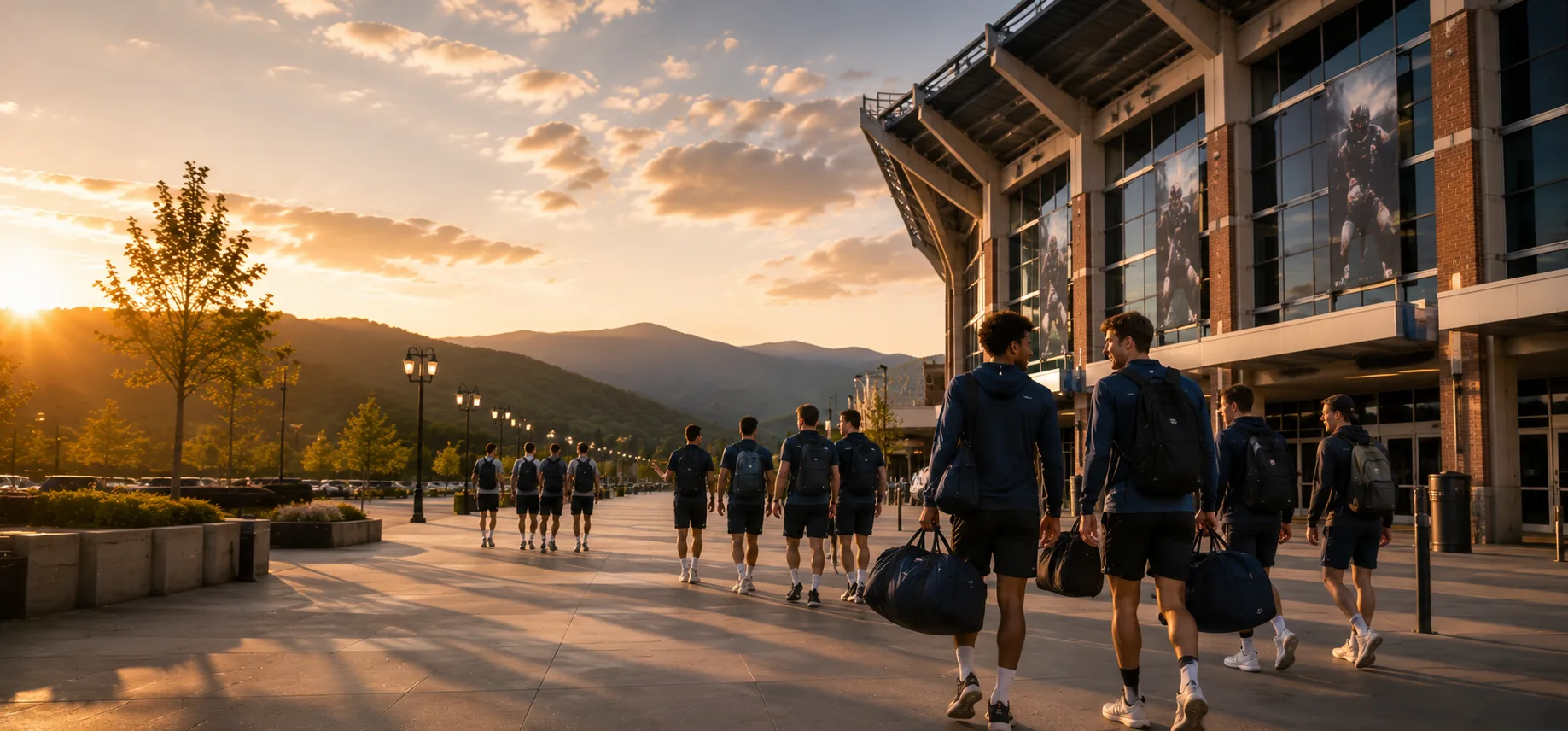

Plan college team travel to Asheville. Charter logistics, venue guide, tournament itinerary, and planning checklist for athletic departments.
Asheville and Western North Carolina are increasingly popular destinations for college athletics travel — hosting tournaments, invitationals, training camps, and conference competitions. The region offers accessible interstates, quality athletic facilities, year-round competition windows, and a mountain setting that supports team bonding and recovery between games.
Key At a Glance — College Team Travel to Asheville
- Best for: Basketball · Soccer · Volleyball · Baseball · Softball · Cross Country · Track & Field · Swimming · Wrestling · Cheer & Dance · Club Sports
- Vehicle options: Activity buses (28–36 passengers) · Full-size motorcoaches (40–56 passengers)
- Equipment: Under-coach luggage bays handle full athletic equipment inventories — gear bags, medical kits, video equipment, and more
- Service area: Asheville and Western NC · Charlotte · Raleigh · Knoxville · Atlanta · Columbia · Greenville and beyond
- Common trip types: Tournament weekends · Invitationals · Training camps · Conference competitions · Preseason travel
- Book: 4–8 weeks in advance minimum · Peak fall/spring season fills faster
A Transportation and Planning Guide for Athletic Departments
Athletic departments moving teams across the Southeast know that transportation logistics don’t get easier with distance. A program traveling to Asheville for a tournament weekend faces the same variables every operations coordinator deals with: roster management, equipment, coaching staff, athletic trainers, meal timing, hotel coordination, and the non-negotiable requirement that everyone arrives on time and in the right condition to compete.
Asheville and the Western North Carolina region have grown significantly as a collegiate athletics destination. The combination of accessible interstates, quality competition facilities, a compact and walkable destination city, and a mountain setting that genuinely supports recovery and team cohesion has made it a recurring stop for programs across multiple sports and conference levels.
This guide is written for athletic directors, operations coordinators, coaches, and team managers who are planning college team travel to Asheville. It covers the region’s sports infrastructure, how transportation decisions affect team performance, what a well-planned tournament weekend looks like, and what to have in place before the bus leaves campus.
Why Asheville Has Become a Collegiate Athletics Destination
Regional location and interstate access
Asheville sits at the intersection of I-26 and I-40 in Western North Carolina, making it accessible from most of the Southeast, Mid-Atlantic, and lower Midwest within a day’s drive. Programs from Tennessee, Georgia, South Carolina, Virginia, and the Carolinas can reach Asheville without an overnight outbound leg for most regional competitions. That’s a logistical advantage that operations coordinators notice quickly when building a travel schedule.
A year-round competition window
Western North Carolina’s climate supports year-round outdoor competition with some planning. Spring sports find mild temperatures and mountain scenery that make the region appealing for invitationals and scrimmages. Fall is ideal for cross country, soccer, and outdoor events. Indoor venues serve winter sports through the colder months. The range of facilities in the region — indoor arenas, outdoor fields, recreation complexes — means that multiple sport types can schedule meaningful competition here across the calendar.
Facilities and the local collegiate environment
UNC Asheville is a Division I program competing in the Big South Conference, and its athletics facilities serve as both competition venues and a reference point for visiting programs navigating the local sports infrastructure. The city’s sports commission — Explore Asheville Sports — actively recruits and supports collegiate tournaments and invitationals, which means the region has a functioning infrastructure for managing visiting teams. That includes coordination on venues, housing blocks, and in some cases logistical support for tournament management.
Recovery and team environment
The mountain setting is not just scenery. Elevation, clean air, relatively low urban density, and the presence of outdoor spaces within a short distance of the competition venue create conditions that support athletic recovery in ways that downtown urban destinations often don’t. Teams note the difference. Access to trails, water, and open space makes the recovery windows between competition days more genuinely restorative.
Sports That Regularly Travel to Asheville and Western NC
Different sport types have different travel needs, and Asheville’s facility mix serves several of them well.
Basketball
Indoor competition venues in the region, including Harrah’s Cherokee Center — Asheville, have hosted significant events. Programs traveling for invitational tournaments need reliable early-morning and late-evening transportation windows, equipment for a full squad, and hotel proximity to the competition venue. Multi-game tournament weekends compress the scheduling, so transportation that can move quickly between hotel, venue, and meal locations matters.
Soccer
Spring and fall weather make Western North Carolina well-suited for collegiate soccer invitationals. Multi-field complexes in the region accommodate simultaneous games across divisions, and programs traveling for weekend tournaments need to move between hotel and fields multiple times over a two-day window. Equipment volume — training gear, balls, medical kits, nets — is manageable in motorcoach luggage bays.
Volleyball
Regional invitational tournaments draw programs from across the Southeast for multi-team weekend events. Volleyball programs travel with significant equipment: pole systems, training nets, ball carts, and medical supplies alongside a full roster and coaching staff. Motorcoach luggage capacity handles this well; rental vans typically don’t.
Cross Country and Track & Field
The Blue Ridge Mountains make Asheville a natural destination for cross country programs. Regional invitationals and cross country meets draw college programs specifically for the terrain, and the mountain setting creates a training environment that programs use for preseason preparation as well as competition. Transportation logistics for cross country and track travel are relatively light on equipment compared to court sports — the primary requirement is reliable on-time arrival at the course.
Baseball and Softball
Spring weather in Western NC supports early-season collegiate baseball and softball, and the region’s multi-field complexes are configured for tournament formats. Programs traveling with full equipment inventories — bats, helmets, catcher’s gear, ball buckets, pitching machines for warmups — require substantial cargo space. Full-size motorcoach luggage bays are the practical solution for a full program’s equipment complement.
Swimming and Aquatics
Collegiate aquatic programs travel with significantly less bulk than field sports, but precision timing matters even more. Meets run to strict schedules, warm-up windows are non-negotiable, and a bus that arrives late at a competition facility creates a cascade of problems that coaches remember. Reliable scheduling and a driver who understands the stakes of an on-time arrival are more important here than equipment capacity.
Wrestling, Cheer, and Dance
These programs often travel to events with smaller roster sizes than team sports, but they have their own equipment and preparation requirements. Wrestling programs may need access to facilities for weight management protocols, and match-day timing is typically tight. Cheer and dance programs traveling to invitationals or competitions need transport for costumes, props, and performance equipment alongside the team.
Club Sports
Many university club sports programs operate with a fraction of the administrative infrastructure of varsity athletics — which makes transportation planning more complicated, not less. Club programs often manage their own travel budgets and logistics without an operations staff. A reliable charter transportation partner who can work with club sports coordinators directly fills a genuine gap that many programs aren’t otherwise equipped to handle.
Athletic Venues in Asheville and Western North Carolina
Note: Venue details, capacities, and availability change. Contact venues directly to confirm current programming and group booking procedures.
Harrah’s Cherokee Center — Asheville is the city’s primary large indoor venue and has hosted collegiate and professional events. Its location in downtown Asheville, combined with proximity to hotels, makes it the natural anchor for major indoor tournament events in the region.
UNC Asheville Athletics facilities include competitive venues for the university’s Division I programs across multiple sports. Visiting programs competing against UNC Asheville should confirm facility access and logistics through UNC Asheville’s athletics operations department.
Local recreation complexes and multi-sport parks in the greater Asheville area serve as competition venues for soccer, softball, baseball, and outdoor sports tournaments. Explore Asheville Sports, the region’s sports commission, maintains current information on available facilities and can support tournament planning for programs considering Asheville as a host location.
Campus recreation and athletic facilities at Western Carolina University (Cullowhee, approximately 55 miles from Asheville), Mars Hill University (Mars Hill, approximately 25 miles), and Brevard College (Brevard, approximately 35 miles) expand the regional footprint for collegiate competition and create opportunities for multi-venue event formats.
See details on Explore Asheville
Planning College Team Transportation: What Operations Coordinators Need to Know
Transportation is often the variable that makes or breaks a tournament weekend. Here’s how experienced operations coordinators approach the logistics.
Roster and headcount management
Final roster counts determine vehicle sizing, and vehicle sizing affects everything from cost to logistics. Build in a buffer — a team that lists 28 traveling athletes may add two late-cleared athletes and an additional athletic trainer the week before departure. The gap between “roughly 30” and “confirmed 34 with staff” is the difference between a vehicle that works and one that doesn’t.
Provide a confirmed departure list to your transportation company as early as possible, and communicate any changes as they occur. A transportation company that can adjust quickly when rosters shift the week before travel is worth the relationship.
Equipment and cargo
Collegiate athletics programs travel with more gear than most trip planners initially account for. Beyond uniforms and personal bags, consider: medical kits and training supplies, sport-specific equipment, video equipment for film review, nutrition and hydration supplies, and any promotional or event materials. Catalogue what’s traveling before you select a vehicle — it prevents surprises at the loading dock.
Full-size motorcoach luggage bays handle substantial cargo. Programs with unusually large equipment inventories — pitching machines, portable nets, wrestling mats — may need to coordinate a separate equipment vehicle or confirm in advance that cargo volume fits the selected vehicle.
Coaching and support staff
Coaches, athletic trainers, team managers, film staff, and administrative support often add 6–10 people to a traveling party beyond the playing roster. Count everyone. A program that reserves based on roster size alone and then adds staff at the last minute creates a vehicle capacity problem that’s difficult to solve on departure morning.
Meal scheduling and nutrition
Game-day nutrition is not a casual planning variable for collegiate programs. Meal timing relative to competition windows matters. Pre-game meals, post-game recovery nutrition, and overnight meal logistics for multi-day trips should be planned in advance and communicated to your transportation company so that vehicle timing supports your program’s nutrition protocols — not the other way around.
For programs with specific dietary requirements or team nutrition plans, confirm food access at the destination before departure. Asheville’s food service infrastructure is strong, but restaurant capacity for groups of 40+ in a single seating requires advance reservations.
Scheduling departure and arrival windows
Build more buffer into your schedule than you think you need. A program departing for a Friday evening hotel arrival that builds no margin for traffic, stops, or loading delays is running on optimism. A Friday night arrival should have a planned and a contingency arrival window, and the competition schedule should assume the later of the two when setting Saturday morning wake-up and departure times.
Departures on return day are the other common failure point. Programs that schedule a 9:00 AM Sunday departure for a tournament that might run to Sunday afternoon are creating a conflict. Confirm competition end times before locking your return transportation schedule.
Why Charter Buses Work Better Than Rental Vans for College Team Travel
Athletic departments sometimes default to rental vans for cost-comparison reasons. Here’s the full picture:
| Factor | Charter Motorcoach | Rental Vans (multiple) |
| Team stays together | Yes — single vehicle | No — team is split |
| Equipment capacity | Large under-coach bays | Very limited |
| Licensed commercial driver | Yes — CDL, professionally qualified | No — often a coach or staff member |
| Driver fatigue | Managed by professional, regulated | Coach or staff absorbs travel burden |
| Onboard amenities | Reclining seats, climate, restroom, power | Standard passenger van configuration |
| Scheduling reliability | Professional transport company | Dependent on van driver’s other responsibilities |
| Insurance and liability | Commercial carrier coverage | Institutional rental policy, personal driver exposure |
| Cost at 30+ people | Often comparable or favorable | Multiple vehicles, multiple drivers, fuel, parking |
| Athlete preparation on-board | Film review, meetings, recovery | Not feasible |
The coaching staff driver situation deserves particular attention. A coach who drives a 12-passenger van for six hours before a competition is not at their best as a coach. The fatigue, concentration cost, and liability exposure of using coaching staff as drivers is a genuine operational risk that charter transportation eliminates entirely.
Learn more about Young Transportation’s college athletics charter services here.
What the motorcoach provides beyond the seat
For collegiate athletics, the vehicle is a mobile team environment. A team that boards a motorcoach together and travels together arrives as a unit — mentally, physically, and in terms of preparation. Coaches can conduct pre-game meetings. Film staff can run video review on the road. Athletic trainers can work with athletes during transit. The travel time is not dead time.
A rental van caravan is the opposite of that. It fragments the team, disperses coaching attention, and adds road fatigue to a day that already includes competition.
Team Travel Safety Best Practices
Professional drivers. Every Young Transportation driver holds a commercial driver’s license (CDL) and operates under federal Hours of Service regulations. Driving time, rest requirements, and vehicle condition are all subject to DOT standards that don’t apply to staff drivers or rental vehicles.
Weather awareness. Western North Carolina’s mountain terrain creates weather variables that are more significant than those in flat-terrain destinations. Mountain fog, ice on elevated roadways, and rapid weather changes on the Blue Ridge Parkway are real considerations, particularly for fall and winter travel. Work with your transportation company on departure timing and route selection during weather-sensitive windows — an experienced regional carrier knows which routes to avoid when conditions deteriorate.
Communication protocols. Confirm in advance how your team’s point of contact will communicate with the driver and the transportation company on travel day. Every athletic operations coordinator on the road should have a direct contact number, not just a general booking line.
Emergency preparedness. Transportation-side emergencies — vehicle issues, accidents, medical situations — should be covered in your team’s pre-departure briefing. Know the company’s emergency contact protocol, confirm that athletic trainers have what they need for medical response, and ensure that your team’s travel documentation (insurance cards, emergency contacts, medical clearances) travels with the team.
Athlete accountability. Departure time is departure time. Build a roster check protocol into your loading procedure — a missed athlete is far easier to resolve before the bus leaves than after. Designate a travel party manager whose job includes confirming the count before departure.
Sample Weekend Tournament Itinerary
This itinerary represents a typical two-night tournament travel weekend for a collegiate team traveling 3–5 hours to Asheville.
Friday
3:00 PM — Campus departure
Final roster confirmed. Equipment loaded. Coaching staff briefed on travel schedule. Medical staff confirms supplies are aboard.
4:00–8:00 PM — Travel
On-board time used for pre-game meetings, film review, or individual preparation at coaches’ discretion. Driver manages a scheduled rest stop.
8:00 PM — Hotel check-in
Confirm room assignments in advance to minimize check-in time for large groups. Meal at hotel or pre-arranged nearby restaurant — advance reservation required for groups of 30+.
9:30 PM — Team meeting, lights-out protocol
Confirm Saturday morning schedule. Collect devices if team policy requires. Establish designated chaperone protocol for overnight.
Saturday
7:00 AM — Wake-up
7:30 AM — Team breakfast
Hotel group breakfast or pre-arranged nearby option. Confirm dietary requirements with hotel food service in advance.
9:00 AM — Depart for venue
Allow 30–45 minutes more than GPS suggests for group loading and equipment transfer.
10:00 AM — Arrive at venue
Warm-up, facility walkthrough, team preparation.
12:00 PM — Competition (Game 1)
2:30 PM — Post-game recovery
Nutrition, trainer assessments, brief team meeting.
4:30 PM — Depart for hotel or second venue
7:00 PM — Team dinner
Group reservation at a downtown Asheville restaurant, hotel dining, or catered team meal depending on program protocol and budget.
9:00 PM — Recovery, room time
Sunday
7:30 AM — Breakfast
9:00 AM — Depart for venue
10:00 AM — Final competition window
1:00–2:00 PM — Competition concludes
2:30 PM — Load bus, depart for campus
Travel time 3–5 hours — arrive campus late afternoon/evening
Note: Sunday departure timing should be confirmed against the competition bracket. Elimination formats mean Sunday schedules can extend significantly. Build your return window around the latest realistic scenario, not the earliest.
Team Bonding Opportunities Around Asheville
Tournament weekends aren’t only about competition. Asheville offers accessible options for team time that don’t require elaborate planning.
Downtown Asheville is walkable, compact, and has a strong independent restaurant culture. A group dinner in the River Arts District or on Lexington Avenue gives a team a genuine local experience without requiring a bus or significant logistics. Most restaurants require advance reservations for groups of 10 or more.
Blue Ridge Parkway is a 20-minute drive from downtown and offers overlooks, short walks, and mountain scenery that translates directly into memorable team time. The Craggy Gardens area and the Black Balsam trailhead are accessible, low-logistics options for teams with a free morning.
Outdoor recreation. For programs with a free afternoon, the French Broad River, Bent Creek trails adjacent to the NC Arboretum, and Pisgah National Forest’s day-use areas offer outdoor options within 15–30 minutes of central Asheville. Confirm with the team what activity level is appropriate for a competition weekend — recreational hiking the morning before a game and recreational hiking the morning after are different decisions.
Local attractions and arts. The Folk Art Center on the Blue Ridge Parkway, the River Arts District working studios, and downtown galleries give teams a brief exposure to what makes Asheville genuinely distinctive — useful context whether the team is there for a weekend or considering the region as a recurring travel destination.
Transportation Planning Checklist for College Athletics Travel
Use this checklist in the 2–4 weeks before departure and review it again the day before.
Roster and logistics
- Final traveling roster confirmed with athletic operations
- All staff, trainers, and support personnel counted and included
- ADA or accessibility needs documented and communicated to transportation company
- Equipment inventory catalogued and cargo space confirmed with driver
Transportation
- Charter vehicle booked and confirmed with transportation company
- Vehicle type verified against confirmed headcount plus staff
- Pickup location, departure time, and staging area confirmed
- Return schedule confirmed against competition bracket
- Driver direct contact number distributed to operations coordinator and head coach
- Backup communication protocol established
Hotel and meals
- Hotel block confirmed with room assignments distributed
- Group breakfast arrangements confirmed with hotel food service
- Friday and Saturday dinner reservations confirmed
- Post-game recovery nutrition plan communicated to hotel or catering
- Dietary restrictions and allergy requirements documented and shared
Competition logistics
- Venue address, parking/staging area, and facility contact confirmed
- Competition schedule printed and distributed to travel party
- Warm-up windows and facility access times confirmed with host
- Opponent and tournament bracket reviewed for schedule contingencies
Safety and administration
- Athlete emergency contacts collected and carried by athletic trainer
- Medical clearances current and documentation on hand
- Health insurance cards collected or copies in team binder
- Athletic trainer supplies inventoried and packed
- Team travel policy reviewed with athletes
- Departure roster protocol assigned to travel manager
Conclusion
Reliable transportation is not a logistical afterthought for collegiate athletics — it’s part of the performance infrastructure. A team that arrives together, on time, in a vehicle that supported recovery and preparation, is in a better position to compete than one that spent the travel day fragmented across a van caravan managed by tired coaches.
Asheville and the Blue Ridge region have the facilities, the regional accessibility, and the destination appeal to make strong collegiate athletics travel destinations — for tournaments, invitationals, training camps, and conference competition. The region’s sports commission infrastructure, combined with local experience in handling collegiate groups, reduces the planning burden on visiting athletic departments significantly.
If you’re planning college team travel to Asheville or anywhere in Western North Carolina, our team is ready to work through the transportation logistics with you — vehicle selection, pickup coordination, staging, and scheduling built around your competition calendar.
Request a Quote — no obligation, and we typically respond within one business day.
Or call us directly: (800) 622-5444
Questions People Ask
How far in advance should college teams book transportation for Asheville travel?
4–8 weeks is a workable minimum for most single-vehicle trips. Tournament weekends in fall and spring — particularly those with multiple teams or conference events — can create high demand for full-size motorcoaches. Programs planning travel during peak collegiate sports windows should book as early as the competition schedule is confirmed.
Can charter buses carry full athletic equipment inventories?
Yes. Full-size motorcoaches have under-coach luggage bays designed for significant cargo. Most collegiate sports programs — including court sports with full equipment kits, medical supplies, and video gear — fit comfortably. Programs with unusually large or awkward equipment (portable nets, pitching machines, wrestling mats) should describe their cargo when requesting a quote so the right vehicle configuration is confirmed.
How many athletes fit on a motorcoach?
Full-size motorcoaches seat 40–56 passengers. Mid-size activity buses seat 28–36. The right vehicle depends on your complete traveling party — athletes, coaches, trainers, managers, and staff — not just the roster. For a breakdown of vehicle options, see our fleet page or Charter Bus Sizes Explained.
Are charter buses appropriate for overnight travel to competitions?
Yes. For programs traveling longer distances where overnight transit makes operational sense, motorcoaches are equipped for extended travel — reclining seats, climate control, restrooms on full-size coaches. For most trips in the 3–6 hour range from regional campuses to Asheville, a daytime or early-evening departure is preferable for athlete recovery.
Can multiple pickup locations be arranged for a single trip?
Yes. Programs that need to pick up athletes from multiple campus locations, or that need to coordinate staff pickups from different points, can arrange multi-stop departures. Communicate this when requesting a quote so timing and routing can be built into the schedule accurately.
What onboard amenities are most useful for athletic teams?
Reclining seats for recovery, climate control, restrooms (full-size coaches), power outlets for device charging, and sufficient luggage space are the practical priorities. Wi-Fi is available on some vehicles — useful for film review and team communication on the road. Confirm amenity availability when selecting a vehicle.
Can Young Transportation support tournaments that involve multiple teams traveling simultaneously?
Yes. Programs coordinating transportation for multiple teams — such as a hosted invitational where several visiting programs need vehicles — can work with Young Transportation to coordinate multiple vehicles on a shared schedule. Contact our team early in the planning process for multi-team logistics.
What should athletic departments prepare before the departure day?
Confirmed headcount (athletes + all staff), finalized equipment inventory, venue address and staging information, hotel block confirmation, competition schedule, and emergency contact documentation for all travelers. The more information the operations coordinator has confirmed before departure day, the fewer variables need to be managed on the road.
How does charter transportation compare to rental vans for athletic department budgeting?
For groups of 30 or more, a motorcoach is often comparable to or less expensive than coordinating multiple rental vans when all costs are counted: vehicle rental, insurance, fuel, parking, and the cost of using coaching or staff time for driving. The safety and performance advantages of a professional driver and a single-vehicle team environment are independent of the cost comparison.
Does Young Transportation serve competitions outside of Asheville?
Yes. Young Transportation serves collegiate and group travel across Western North Carolina and the broader Southeast. Programs traveling through the region for away competitions, multi-stop road trips, or return legs from other destinations can coordinate full transportation plans through our team.